I’ve decided to republish a book. Someone on the fediverse – I can’t remember who – said that Professor Mmaa’s Lecture was their favorite book. So I wrote to the rights holder to see if I could get it back into print. Sorry, I know I’m supposed to be working on the game, but it’s been a busy summer and I’ve had a hard time getting a free moment. Also, I first inquired about these rights a couple of years ago, but just heard back. I’ve been telling everyone that I bought my first book ever, just to confuse people.
The agent that I ended up speaking to was a little surprised to hear from someone who had never published a book before. I can only plead that I have figured out how to make games, so surely I can figure out how to make books happen. Also, I happen to know a fair bit about copyright law since I used to work on legal issues in software freedom. (Actually, I apparently know more about copyright law than Amazon, which initially rejected the book because they thought it was in the public domain. They relented when I explained.) You can just do things.
What follows are some notes on what the process has been like. To start with, the contract. I feel confident that I could have written a book contract, but why bother, because the Authors Guild has a great model contract. I mean, it’s great for authors (as you would expect). But also, it explains the reasons behind each term in clear English. I didn’t want to use it verbatim because this is a reprint, so the rights issues are different (and I disagreeed with some of its terms). Claude made me a new contract inspired by the Authors Guild one, and I confirmed that it was what I wanted. I had to remind Claude about the read-aloud issue; obviously, I want the book to accessible to blind and other reading-impaired people! And its internal review of the first draft surfaced like nine missing clauses. Ask Claude to review its work; you’ll almost always find something worth fixing.
Then it was time to prepare the text. In the old days, Dover would do photo facsimilies of public domain works they wanted to republish. This was not beautiful, but it totally did the job with 20th century technology. We’re in the 21st century now. You can scan a book and OCR it. OCR often gives weird scanning mistakes, especially if your book has non-English text interspersed. Historically, you would clean them up by hand. Now we have LLMs to do it for us. I should warn that this is not 100% perfect, especially as regards to formatting. Professor Mmaa’s Lecture has illustrations, tables, subscripts, small caps, italics, etc. They all have to be manually checked. But I have found no errors in the text itself. You might thing it’s easy to find scannos – just search for non-words. But this book is full of hapax legomena. “Brillat-Beetonin”, “kcourage”, “Homomahomet”, “abbovvve”, “Maetermith”, to name just a few. Oh, also, untranslated French. LLMs do it without breaking a sweat. Archivists have known about this LLM superpower for a couple of years.
I had initially thought that I would work off the Internet Archive’s scan of the book. Unfortunately, their scan is the 1975 edition, and the rights holder wanted me to use the 1953 edition. There are pretty major differences – the 1975 edition is actually almost 20% longer. There are new bits everywhere. Here’s one:
“If we add to this the thesis propounded by the very reverend Archussher, who, basing his conclusions on right-to-left consumption of the collection of cellulose which consumed from left-to-right is known as Genesis v, declared that according to homo itself its appearance took place at nine in the morning of October 28, 4004 B.C. of the homo calendar&emdashwe shall realize what discrepancies there are among the various estimates of this mammifer’s age, even if we agree to call homo what by some scientists is called ’notyethomo,’ and by others: nomorehomo.
In addition to the new bits, the 1975 version has some minor rewordings – like, “everyone” gets the MLP treatment and becomes “every termite”. It also has American spellings. And it doesn’t have Bertrand Russell’s preface.
So then I thought I would just photograph each page and have Claude OCR it. Tedious, but doable. Just to test it out, I went to the Claude web interface and asked it to do the first page. It refused, citing copyright law. Buddy, don’t you remember how you, yourself, were trained? Anyway, it suggested instead that I use a book-scanning service. Why are you giving me instructions about how to “infringe copyright” after refusing to do it yourself? (It didn’t believe me when I told it, honestly, that I had the rights).
I found a place called 1DollarScan. They said to email them if I wanted the original book back, so I did, and then they quoted a price that was… not one dollar. Indeed, it was closer to a dollar a page. So instead, I went with Bound Book Scanning. Their pricing was much more reasonable (still not one dollar), and they did a great job.
And Claude Code doesn’t seem to care about copyright. I mean, it politely asked if I had the rights to Bertrand Russell’s preface before including it (I didn’t, so I went out and got them). But otherwise, it’s perfectly happy to clean up scans. It’s not quite the same job – it’s working from an existing scan rather than doing 100% of the OCR itself. But actually Claude Code ends up doing a bunch of OCR anyway.
It’s a little scary to entrust text to a LLM – they are famous for hallucinating. (I know some people think that hallucinations have been fixed – they haven’t. I just asked Claude to find me some boxer shorts, and it confidently, wrongly, asserted that Israel doesn’t have an underwear industry.) But for OCR, it turns out that Claude can do a good job even with text that’s somewhat out-of-distribution, like this novel.
Some decisions need to be made specifically for ebook publication. Lots of people read books on their phones, which means that poetry will, unfortunately, have extra line-wraps. Consider:
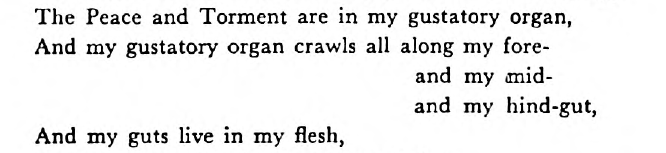
Here, fore-, mid-, and hind- are all aligned at the dash to indicate that they all refer to sections of the gut. But on my Pixel 9, with default Kindle settings, portrait mode, “And my gustatory organ crawls all along my” takes up a whole line, wrapping fore- onto the next line. We decided to wrap “my” onto the next line, and keep the dashes aligned. There’s no perfect solution here, but I think this does the best job of preserving Themerson’s intent. Claude took a few tries to get this to look right on various screen sizes, but managaed in the end. And of course, if you have a larger screen, and in the print version, we won’t wrap.
That’s an aesthetic challenge; there were also technical challenges. There’s one bit in the book where “the Detective imitates the sound of the old Enemy of termites – the Dove.” This is rendered as… well, I don’t actually have names for these characters. They’re straight lines and arcs, with accent marks. I almost ended up rendering the arcs as U+2323 SMILE; the straight lines as em-dashes and vertical bars. But using combining accents didn’t render right, so Claude suggested using ruby, which I had known about (I tried to learn Japanese at one point) but wouldn’t have ever thought to use. Brilliant idea, except that the Kindle renders the ruby too far above the smiles, and it doesn’t support the CSS necessary to fix it (we discovered this after Claude built me a little tool that would let me interactively adjust the size/height of the accents to get it just right). So, not actually brilliant. Then I tried using images of Themerson’s original glyphs instead. But they were black-on-white, which looks bad in dark mode (and Kindle doesn’t support the CSS that would let me select different images for dark mode). The final plan ended up being to trace Themerson’s notation into a font, and embed the font. Yow.
Anyway, after a bunch of irritating formatting tweaking, the 1953 original text of Professor Mmma’s Lecture was ready to go!
Oh, and I needed a web site, which meant a domain name, and thus a business name. I do most projects under my own name, so that everyone knows what they’re going to get: something weird. But publishers tend to have business names, and anyway it felt odd to have my name on a book someone else wrote. I chose the name Picolibrary to emphasize that this was just a small side project. I know sometimes small projects get big. Bennett Cerf said, “we just said we were going to publish a few books on the side at random”, but ended up with Random House. I do not expect this to happen to me. Still, I have a bunch of spare ISBNs (in the US, if you want two you might as well buy ten), so anything’s possible.
I asked Claude to put together the site, and it came up with some hilariously Claude text about what the press is and what its mission is, all totally made up. It genuinely used the word “genuinely”, in case any readers were genuinely unsure whether or not it was slop. I deleted it and used my own voice. (To be clear: this was always the plan; I don’t use AI prose generation for anything I share with others, as I find it painful to read).
So now if you want to read one of the weirdest books I’ve ever read (and I’ve read House of Leaves), now you can read Professor Mmaa’s Lecture. It’s about what it’s like to be a termite. Bertrand Russell recommends it!
Previous post: Is it a joke?